

OSHA Fixed Ladder Requirements 2026: A Complete Compliance Guide
Falls remain one of the most common causes of serious work-related injuries and deaths. For facility managers and safety officers, keeping up with regulation changes isn't just about avoiding fines—it is about ensuring every worker goes home safely at the end of the day.
If you manage a facility with fixed ladders, you are likely aware that OSHA regulations underwent a massive shift starting in 2016. Now, in 2026, we are well into the implementation phase of these updated standards. The days of relying solely on metal cages for safety are over. The focus has shifted entirely to active fall arrest systems.
This guide breaks down the current OSHA safety requirements for fixed ladders, helping you navigate the technical specifications, understanding the phase-out timelines, and ensuring your workplace meets the highest safety standards.
The Core Rule: Fall Protection Above 24 Feet
The most significant regulation you need to know affects any fixed ladder that extends more than 24 feet above a lower level.
Under OSHA standard 1910.28(b)(9), the traditional safety cage is no longer considered compliant fall protection for new installations. Instead, OSHA requires a strictly defined set of active safety measures.
If you are installing a new fixed ladder today, or if you are replacing a section of an existing ladder that is over 24 feet tall, you must equip it with one of the following:
- A Personal Fall Arrest System (PFAS): This typically consists of a body harness, a lanyard, and an anchor point.
- A Ladder Safety System: This is a system attached to the ladder itself, usually involving a rigid rail or cable and a carrier that attaches to the worker's harness. If the worker slips, the system locks immediately to arrest the fall.
The End of the Safety Cage Era
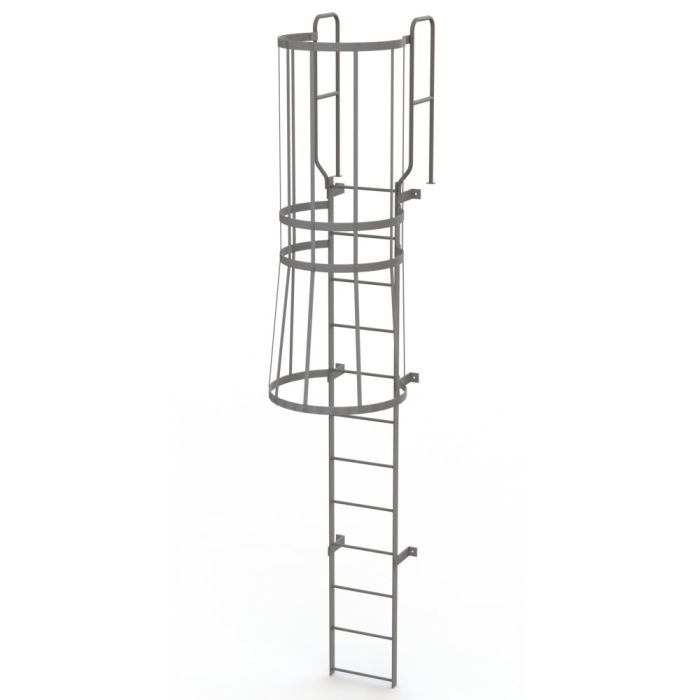
For decades, hoops and cages were the standard. The logic was that a cage would prevent a worker from falling backward off the ladder. However, extensive research and accident data revealed a grim reality: cages do not stop falls. They only contain the falling worker, often leading to severe injuries as the worker strikes the metal hoops on the way down.
Because of this, OSHA has moved away from passive protection (cages) toward active protection (PFAS and ladder safety systems). While cages provide a psychological sense of security, they do not offer the physical protection required by modern safety standards.
The 2036 Deadline Explained
You might look at your facility and see ladders that still have cages. Are they illegal? Not necessarily—yet.
OSHA has provided a grandfather clause and a strict timeline for compliance:
- Ladders installed before November 19, 2018: These can still use cages as their primary fall protection until November 18, 2036.
- The 2036 "Sunset" Date: By November 18, 2036, all fixed ladders over 24 feet must be retrofitted with a PFAS or ladder safety system.
Even though 2036 seems distant, many companies are choosing to retrofit now. Waiting until the deadline approaches can lead to budget bottlenecks and contractor shortages. Furthermore, relying on outdated safety methods exposes your company to liability if an accident occurs before the deadline.
Critical Dimensional Requirements
Beyond fall arrest systems, the physical dimensions of the ladder itself must meet strict criteria outlined in OSHA 1910.23. These measurements ensure that workers have enough room to climb safely without obstructions.
Rung Width and Spacing
The rungs are the most critical contact point for a climber. To ensure stability:
- Minimum Width: Ladder rungs must have a clear width of at least 16 inches. This gives the climber ample room to place their feet securely.
- Spacing: Rungs must be spaced between 10 and 14 inches apart, uniform throughout the length of the ladder.
- Shape: Rungs must be shaped or treated to minimize slipping (e.g., corrugated, knurled, or coated with skid-resistant material).
Clearances and Grab Bars
A climber needs space to move. If a ladder is too close to a wall or surrounded by obstacles, the risk of a fall increases.
- Back Clearance: There must be at least 7 inches of clear space from the centerline of the rung to the permanent object behind the ladder (like the wall or tank it is attached to). This ensures the climber's boot can fit fully on the rung.
- Side Clearance: For ladders without cages, there must be at least 15 inches of clearance on each side of the ladder centerline.
- Grab Bars: When a ladder terminates at a landing or access level, grab bars must extend 42 inches above the landing surface. This allows the worker to maintain a firm grip while transitioning from the ladder to the platform.
Landing Platforms and Rest Breaks
Climbing a tall ladder is physically demanding. Fatigue is a major contributor to slips and falls. OSHA addresses this through requirements for landing platforms.
If your fixed ladder is equipped with a ladder safety system or PFAS (which is required for heights over 24 feet), you generally do not need intermediate landing platforms for fall protection purposes alone.
However, rest is still a factor. For ladders without cages (which should be the standard for new installs), OSHA requires a rest platform at least every 150 feet.
If you have legacy ladders with cages that are over 50 feet in height, you must have landing platforms at maximum intervals of 50 feet.
Material Standards and Durability
The environment where a ladder is installed dictates its material requirements. OSHA requires that metal ladders be protected against corrosion.
- Corrosion Resistance: Ladders exposed to the elements or chemical environments must be made of corrosion-resistant materials like aluminum or stainless steel, or be treated with a protective coating.
- Smooth Surfaces: Ladders must be free of sharp edges, burrs, or splinters that could puncture clothing or injure hands.
Aluminum is often the material of choice for modern fixed ladders. It offers a high strength-to-weight ratio and natural resistance to rust, reducing long-term maintenance costs compared to painted steel.
Why Compliance Matters (Beyond Fines)
Adhering to these regulations is about more than avoiding an OSHA citation. It is a direct investment in operational efficiency.
When workers feel unsafe, they work slower. A worker climbing a 30-foot ladder with an outdated, shaky cage is focused on their fear, not their task. A worker clipped into a modern rail system feels secure, allowing them to ascend and descend efficiently.
Non-compliance can also result in massive financial liabilities. Workplace falls are among the most expensive accidents for employers, costing billions annually in workers' compensation and medical expenses.
Action Plan: Assessing Your Facility
You do not have to wait for an OSHA inspector to show up to find out if you are compliant. You can take proactive steps today.
- Inventory Your Ladders: Create a comprehensive list of every fixed ladder in your facility. Note the height of each one.
- Identify the "Over 24" Club: Flag every ladder that exceeds 24 feet in height. These are your high-priority assets.
- Check Installation Dates: Determine which ladders were installed after November 2018. If any of these use cages instead of a PFAS, you are currently non-compliant and need to act immediately.
- Plan for Retrofits: For older ladders with cages, start budgeting for the retrofit now. You have until 2036, but spreading the cost over several years is smarter than a panic spend in the final year.
- Inspect for Damage: Check rungs for corrosion, loose bolts, or damage. Ensure the 7-inch back clearance hasn't been compromised by new piping or conduit installations behind the ladder.
Conclusion
The transition from cages to personal fall arrest systems represents a significant step forward in industrial safety. While the regulations may seem complex, the goal is simple: ensure that a slip on a ladder results in a minor scare, not a tragedy.
By understanding the 24-foot rule, respecting the dimensional requirements, and planning for the 2036 phase-out, you can build a safer, more compliant, and more productive workplace. Don't wait for the deadline—safety is an immediate priority.