

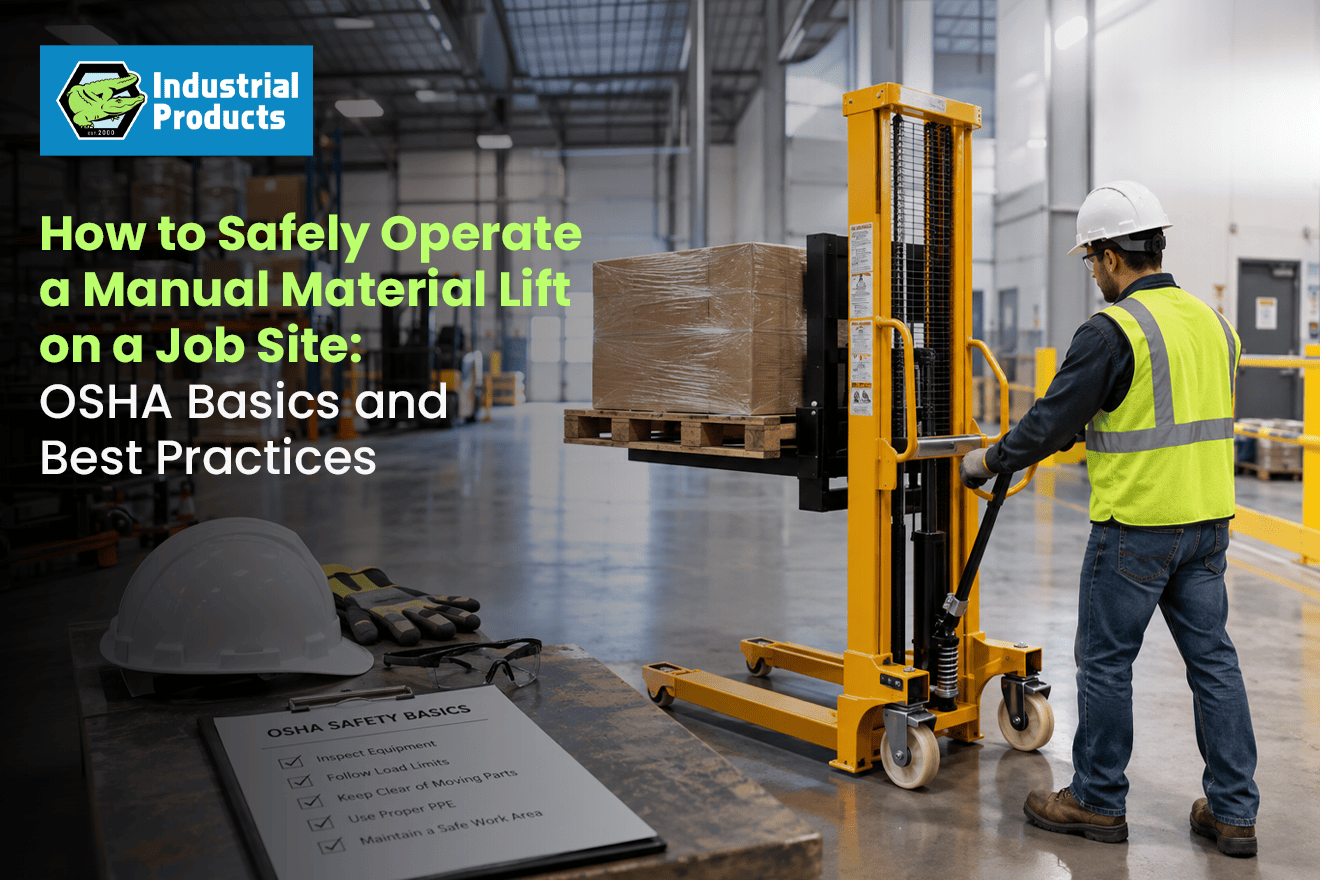
Manual material lifts move heavy loads without the assistance of a forklift. They are typically found in warehouses, loading docks, construction sites, and factories. Although they’re straightforward to use, some accidents can happen when you use them. Lift overload, improper use of the lift on a non-level surface, and inadequate maintenance may lead to the tipping of the lift and/or dropping of the load. One way of ensuring worker safety and maintaining a safe worksite is through educating them about proper use of manual material lifts along with following OSHA safety guidelines.
This guide covers the practical basics: pre-use checks, safe operating habits, common hazards, and the industrial safety equipment and workplace safety products that support safe lift operation.
What Counts as a Manual Material Lift?
A hand lift is a type of power-free material-handling equipment used to move goods. A manual power lift can be operated by hand through a crank system or a hydraulic system. Hand pallet stacker, hydraulic lift table, post table, and hand hoist are some examples of manual lifts. This lift is very popular in warehouses, industry, and building sites without needing a forklift.
These lifts fall under general industry standards, primarily OSHA 1910.176 (materials handling) and, depending on the equipment type, provisions under 1910.178 for powered industrial trucks if the lift has any motorized lifting function. Facility managers should verify the applicable standard for their particular lift, as manual and powered lifts are handled differently.
Pre-Operation Inspection
Before each shift commences, the operator must conduct a routine inspection of:
- Cracks, bends, or wear on the lift structure.
- Wheels or castors to ensure there is no flat or damage which might lead to instability.
- Ensure that the lift mechanism, the hydraulic pump, the hand crank, or the chain are able to operate smoothly without getting stuck or resisting too much.
- Ensure that the load capacity is visible and appropriate for the job at hand.
- For hydraulic lifts, check if there are any hydraulic fluid leaks.
Any lift that fails this test must be tagged out and taken out of service. Failure to do so is one of the leading causes of tip-overs and dropped loads.
Safe Operating Procedures
When the elevator is going through inspection, a few habits in its operation prevent the most injury to it:
- Know the rated capacity. All lifts have a maximum load capacity that is stamped on them. Going over that number, even for a moment, puts you at risk of collapsing or tipping over.
- Center the load. Unbalanced loads will shift the center of gravity and cause the lift to be unstable, particularly when in motion. Keep loads as low and as centered as the lift design allows.
- Move slowly on uneven surfaces. Ramps, broken pavement, and dock plates are the tipping points you will typically run into. Slow down and don’t make any sudden turns when transporting a raised load.
- Lower the load before transport. Traveling with a load lifted higher than necessary elevates the center of gravity and obscures the operator’s line of sight. Hold the load as low as you can while travelling.
- Never exceed the reach or lift height listed by the manufacturer. Extending beyond rated height changes the stability envelope and can cause the lift to tip forward.
Use appropriate PPE: Wear suitable PPE, including safety gloves, steel-toe boots, and eye protection, to minimize the risk of injury when operating the lift. - Keep hands and feet clear of pinch points. Manual lifts have several pinch points around the mast, forks, and lifting mechanism. Gloves and steel-toe footwear reduce the severity of an incident but don't replace careful hand placement.
Common Hazards and How to Avoid Them
Most manual-lifting injuries are preventable with proper safety checks, operator training, and adherence to safe operating procedures.
- Do not overload: Always avoid exceeding the equipment's lifting capacity.
- Check the ground: Make sure that the ground where the lifting will take place is safe and stable.
- Keep the view clear: The operator should have a clear view of what they are doing throughout the lifting process.
- Do not be in a hurry: Operators should carry out safe lifting procedures rather than being in a hurry.
- Conduct a pre-use check: This helps detect faults in the machinery before starting the lifting process.
- Properly train operators: Train operators to interpret machine capacity labels.
- Look out for instability indicators: Stop in case of warning signals such as wheels starting to come off the ground.
Supporting PPE and Equipment for Manual Lift Operations
Operating a manual material lift safely isn't just about the lift itself; it's also about the surrounding PPE & Safety Equipment and site setup. Below are ten product categories that directly support safe lift operation on a job site, all things a facility would already stock or should consider stocking.
- Material Lifts: Hand-cranked and hydraulic material lifts built for raising and positioning loads without a powered motor, sized for warehouse and job site use.
- Pallet Stackers: Including manual drive / manual lift models, used for raising and moving palletized loads at controlled height.
- Lift and Post Tables: Hydraulic tables that raise loads to a working height, reducing repetitive bending and lifting strain.
- Fall Protection: Fall protection kits, safety harnesses, and lanyards for any lift operation performed near elevated platforms, mezzanines, or open edges.
- Protective Wear: Hand and arm protection and head and face protection used to safeguard from pinch point hazards and dropped-load hazards.
- Hi-Visibility Clothing: Hi-visibility clothing worn by lift operators to ensure that they can be seen by forklift operators and any other pedestrians that might be moving around in the same area as the operator.
- Wheel Chocks: Rubber and steel wheel chocks used to secure trailers and other vehicles during loading and unloading.
- Guard Rails: Guard rails, both portable and permanent, that demarcate lift pathways and keep people away from lift areas.
- Job Site Boxes: Secure storage equipment for keeping lift accessories, inspection logs, and maintenance tools organized and protected on site.
- Safety Mats: Anti-fatigue and ground protection mats that give operators stable, non-slip footing around lift stations.
For facilities managing multiple lift types alongside pallets, carts, and dock equipment, browsing material handling and storage options together helps standardize equipment across a site rather than sourcing pieces one at a time.
For facilities managing multiple lift types alongside pallets, carts, and dock equipment, browsing material handling and storage options together helps standardize equipment across a site rather than sourcing pieces one at a time.
Selection Tips
Selecting the right manual material lift improves safety, efficiency, and performance while ensuring it fits your work environment and lifting needs. Lifts used at elevated workstations and loading docks should also have suitable industrial fall protection systems installed.
- Select the appropriate capacity: Choose a lift that is suited for your maximum loads, not your average loads.
- Add some margin of safety: Try not to consistently operate your lift at its maximum capacity.
- Match your lift height requirements: Your lift should be capable of safely reaching the height of your racking systems, shelving, or working surface.
- Assess aisle space: Check that the lift can fit comfortably into your aisles within your warehouse.
- Consider floor conditions: In cases of slopes or uneven floors, select lifts that have large wheels and locking casters.
- Take into account your work environment: Select the right lift based on your work environment.
Conclusion
Manual material lifts are straightforward equipment, but safe operation depends on consistent habits: pre-use inspection, respecting load limits, and keeping the surrounding work area organized and hazard-free. Pairing the right lift with proper PPE, stable footing, and clear travel paths reduces the most common causes of job site injuries.
For businesses looking to equip their facilities with dependable material handling and workplace safety products, Industrial Products offers a wide range of manual material lifts, lifting equipment, and industrial safety products designed to support safer and more efficient operations across warehouses, manufacturing facilities, and industrial worksites.
FAQs
Do manual material lifts require OSHA certification to operate?
Non-powered lifts usually do not require the operator to be certified in the same manner as those classified as powered industrial trucks under 1910.178. But employers still have to train their workers on how to use them safely, as per OSHA’s general training requirements.
How often should a manual lift be inspected?
A visual and functional check should happen before every shift. A more thorough inspection, including hydraulic components and structural welds, should be documented on a regular schedule, commonly monthly or quarterly, depending on usage.
What's the biggest cause of manual lift accidents?
Overloading and operating on uneven or unstable ground are the two most common causes, followed by moving with the load raised too high during transport.
Can one person safely operate a manual material lift?
Yes, the majority of manual lifts are intended for one person to operate them. However, a second person may be needed to assist in moving extra-heavy or cumbersome loads to help guide and stabilize the load.
What PPE is recommended for lift operators?
Steel-toe boots, gloves, and high-visibility clothing are a must. When the lift is operated adjacent to high platforms or unprotected sides, fall arrest equipment is required as well.